

When I was younger, I judged myself by one thing only: did I win today? If I cleared the board in two turns, I went home thinking I was the best player on our street. If I lost to my uncle three boards in a row, I was convinced I had forgotten how to play.
It took me years, and a lot of evenings at the club, to understand that this way of thinking was holding me back. Carrom doesn’t reward you in a straight line. You can practise hard for a month and feel stuck, and then one evening everything clicks. Shots that used to feel like luck start feeling like habit.
The players who improve fastest are not always the most talented. They are usually the ones who know what to look for in their own game. In this article I’ll share what I watch for, the simple tests I use on myself and my students, and how I turn those results into an actual plan.
Why wins and coin counts can fool you
Wins depend on too many things outside your control. Who you played, how the break opened up, whether the board was slow or fast that day, even how much powder was on it. I’ve lost boards where I played some of my best carrom, simply because my opponent got a lucky spread and finished in one turn.
The opposite happens too. I remember beating a much stronger player once and feeling on top of the world. Looking back honestly, he had an off day. I hadn’t suddenly become better than him.
So if you only count wins, you’ll swing between overconfidence and frustration. You need measures that stay steady from one day to the next. That’s what the rest of this article is about.
Seven signs of real progress
1. Your good shots become repeatable
Anyone can pocket five coins in a row on a lucky evening. The question is whether you can do it again tomorrow, and the day after.
I tell my students I’d rather see eight out of ten every single day than ten out of ten once and six out of ten the next. A steady eight means your stance, your grip and your follow-through are settling into a pattern. A wild swing between ten and six means something in your technique is still changing from shot to shot, even if you can’t feel it yet.
2. Your old enemy shots stop scaring you
Every player has a few shots they quietly avoid. For me it was the thin cut into the corner pocket on my left side. For years I would look for any other option rather than play it.
Think about the shots you hated when you started. Maybe the straight shot that always drifted slightly, the cut from near the baseline circle, or the rebound off the side cushion. If a shot that used to take you four or five attempts now goes in on the first or second try, that is progress you can count. Write it down. These small wins are easy to forget.
3. You control the striker, not just the coin
Beginners watch the coin. Good players watch the striker too.
Where does your striker stop after the shot? Does it follow the coin into the pocket and give away a due? Does it sit in the middle of the board blocking your next coin? When you start hitting with just enough speed to pocket the coin and leave the striker where you want it, your game has moved up a level. Speed control is the skill I see improve last in most players, and it makes the biggest difference.
4. You are thinking one shot ahead
Say you have two of your coins near the same pocket. A beginner pockets the easier one and then discovers the second is now blocked by the striker or by a coin knocked into the way.
An experienced player looks at the board first and asks: if I pocket this one, what am I left with? Sometimes that means taking the slightly harder coin first, because it clears the path for the next one. When you notice yourself planning two or three shots as a sequence, your understanding of the game is growing, even if your hands haven’t caught up yet.
5. You can explain your own misses
I used to say “bad luck” after almost every miss. My coach finally told me that luck doesn’t miss the same way three times in a row.
After a miss, take two seconds. Did the striker go where you aimed? If not, your alignment or finger action is off. If the striker went straight but hit the coin on the wrong side, your aiming point was wrong. If the coin hit the pocket edge and bounced out, you probably hit too hard. Once you can name your mistakes, you can fix them. Players who can’t name them just keep repeating them.
6. You make better decisions
Not every shot you can play is a shot you should play.
Here’s a situation I see all the time. You have a difficult cut that might go in. If you miss, though, the coin rolls right in front of your opponent’s pocket and hands them the board. Often the better choice is a softer shot that pockets nothing but leaves your opponent nothing either. Knowing when to attack, when to defend and when to set up your next turn is what separates club players from tournament players.
7. You stay calm when it matters
Plenty of players can pocket the queen in practice. Ask them to pocket and cover it when the board is 23 points each, with people watching, and their hand starts shaking.
Notice how you play in close games. Do you rush? Do you play the shot you practised, or panic and hit harder? If you are making fewer silly mistakes under pressure than you did six months ago, that is one of the most important kinds of progress there is.
Eight tests you can run on yourself
Feelings are unreliable, so I use simple tests. The rules that make them work:
- Same board, same conditions. Use the same board, the same striker and roughly the same amount of powder each time. A freshly powdered board plays much faster than an old one, and that alone can change your score.
- Same setup. Mark the coin positions with a pencil dot or a tiny piece of tape so you place them in the same spot every time.
- Warm up first. Play for ten minutes before testing. Cold fingers give you a false low score.
- Count honestly. A coin that wobbles in off the wrong cushion when you aimed straight is a miss in a test, even if it counts in a game.
Test 1: The straight-shot ten
Place one coin about a hand’s width in front of the pocket, in a straight line from your baseline. Take ten shots, resetting the coin each time.Then do it again with the coin halfway up the board. Score each set out of ten.
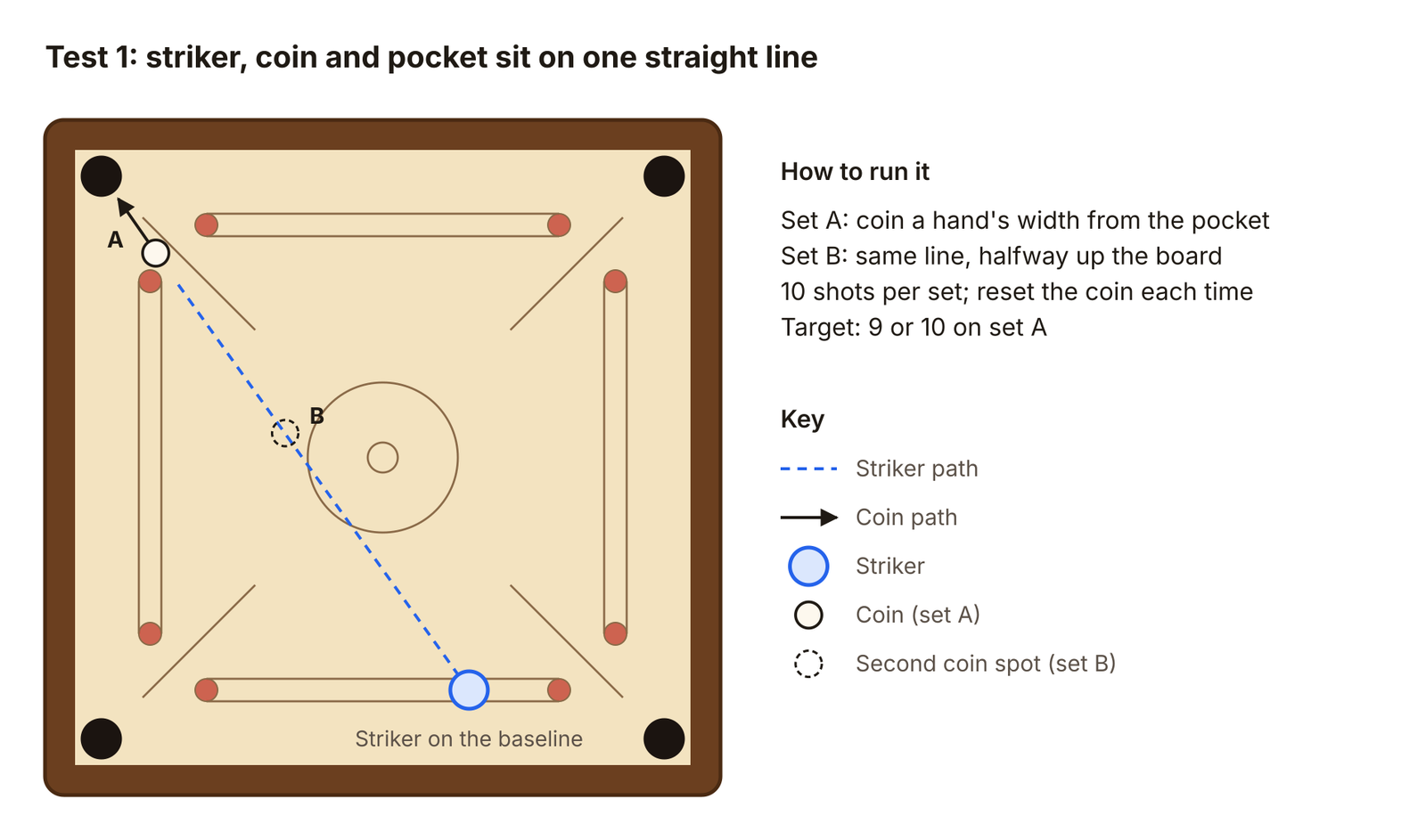
What it tells you: your basic alignment and finger action. A club player should be scoring 9 or 10 on the close coin. If you’re at 6 or 7, nothing else matters yet. Fix this first.
Test 2: The cut-shot ladder
Place a coin near the corner pocket and play it as a cut from your baseline. Start with a gentle angle. Each time you pocket it twice in a row, move the coin to a sharper angle. Count how many “rungs” you climb in 15 shots.
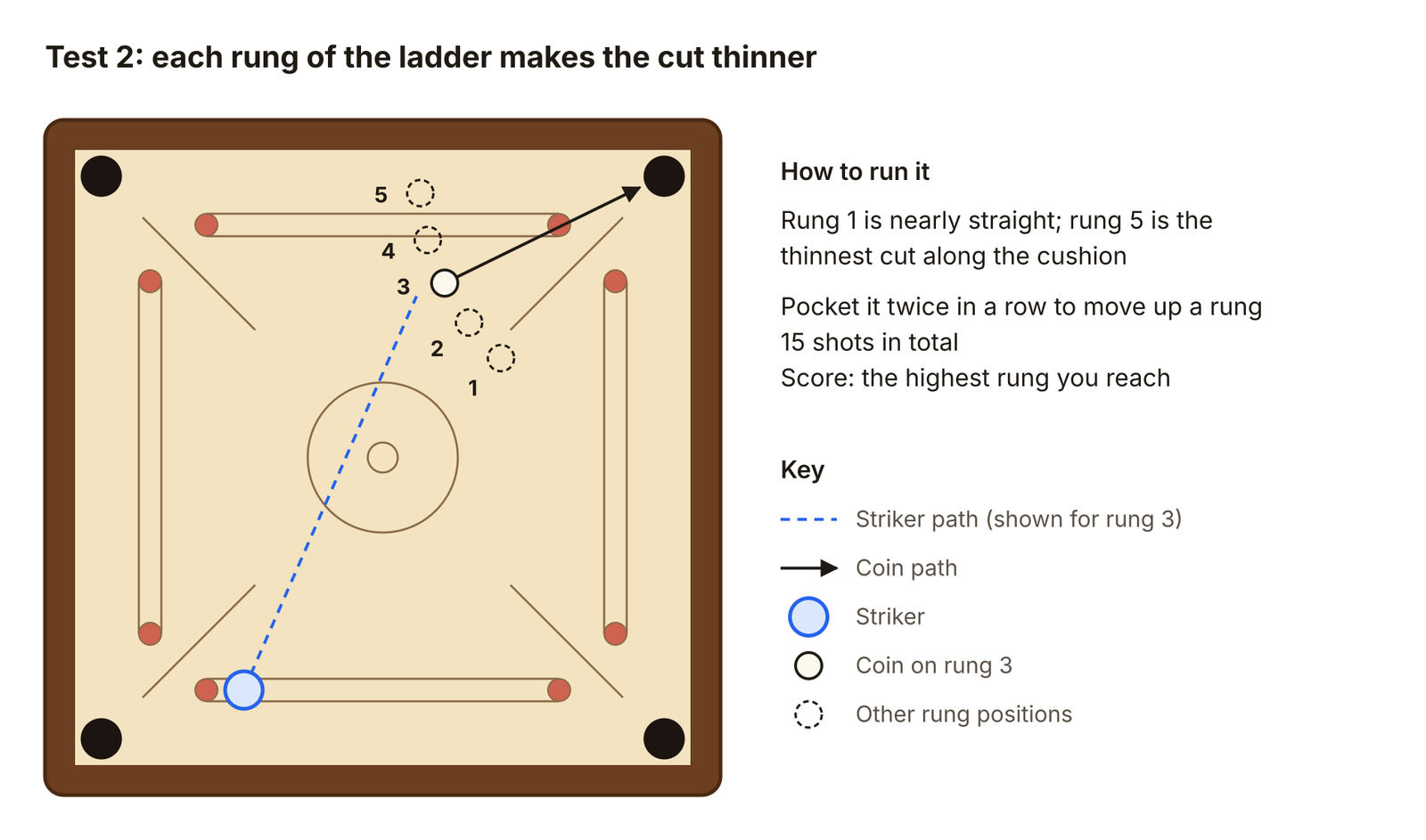
What it tells you: how well you judge the contact point on the coin. When I started tracking this, I was stuck on rung 3 for weeks. Then I changed where I was looking while aiming, and in a fortnight I was on rung 5.
Test 3: Rebounds
Set up five rebound shots where the striker has to come off the front cushion to hit a coin sitting near your baseline. Play each one twice.
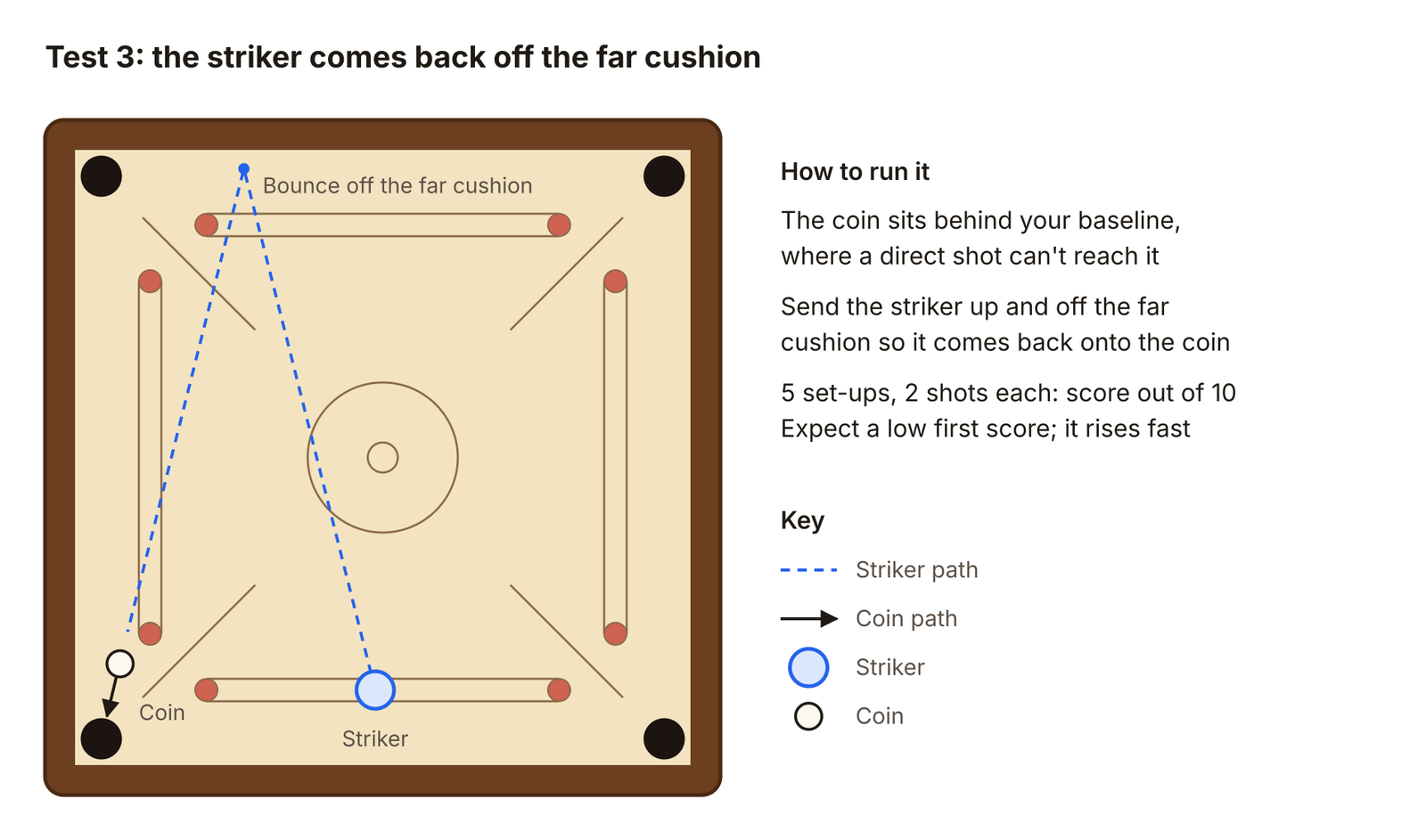
What it tells you: your sense of angles and how the board responds. Most players are weakest here, so don’t be discouraged by a low first score. It is also the test where improvement shows most clearly.
Test 4: Stop the striker
Place a coin a short distance from a pocket. Pocket it ten times, but you only score the point if the striker stays out of the pocket and stops within a striker’s width of where the coin started.
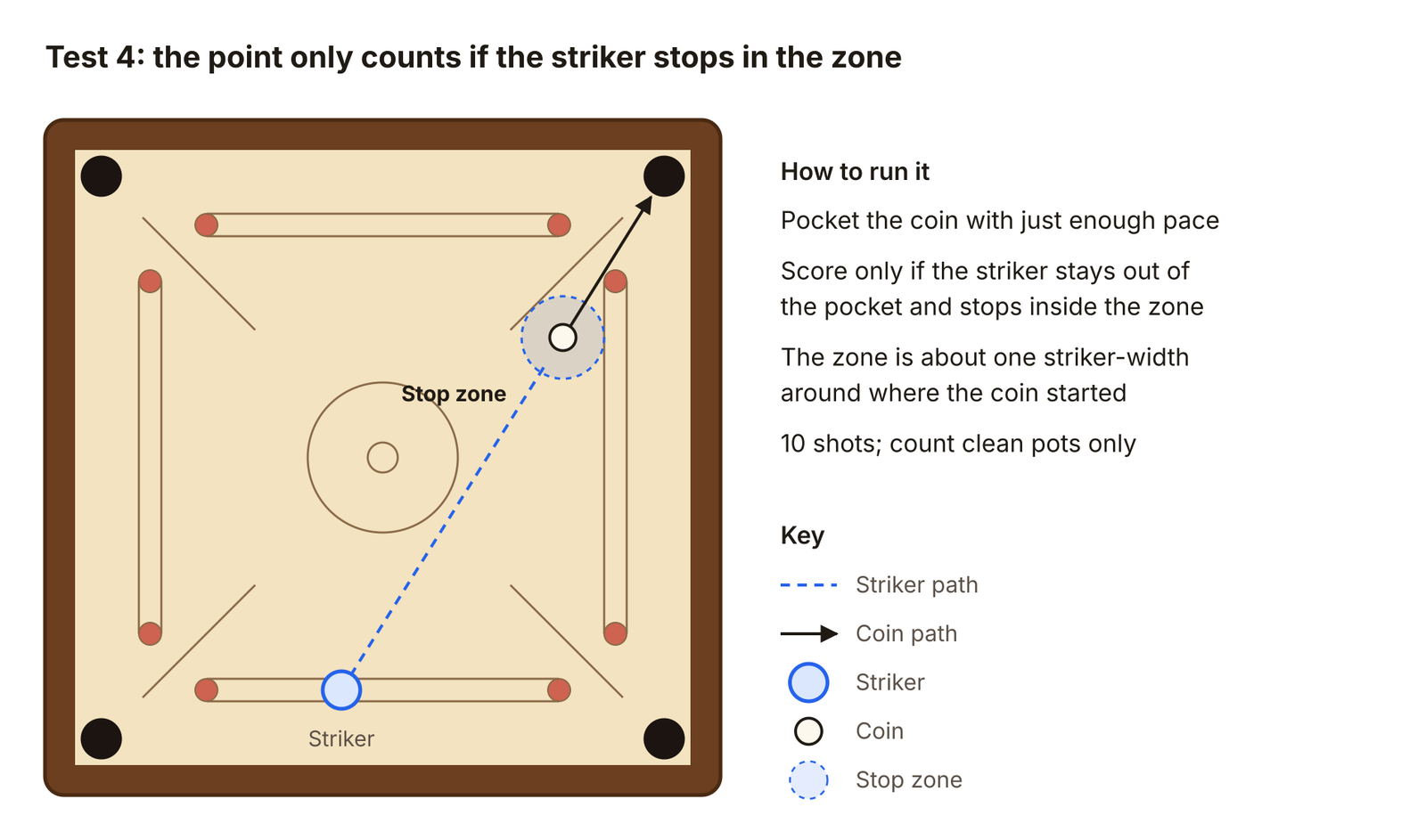
What it tells you: speed control. You will probably pocket the coin far more often than you score the point. That gap is exactly what you are working on.
Test 5: Solo clearance
Break as you would in a game and then clear all nine of your coins on your own, as though you had unlimited turns. Count how many strokes it takes. Every miss counts as a stroke.
What it tells you: the complete picture of your shot-making, positioning and planning. Do this three times and use the average. When I was a beginner this took me well over 20 strokes. A strong player gets close to 12 or 13.
Test 6: Queen and cover
Set the queen in the centre with three of your coins scattered around. Try to pocket the queen and then cover it with your next shot. Ten attempts, and you only score when both go in.
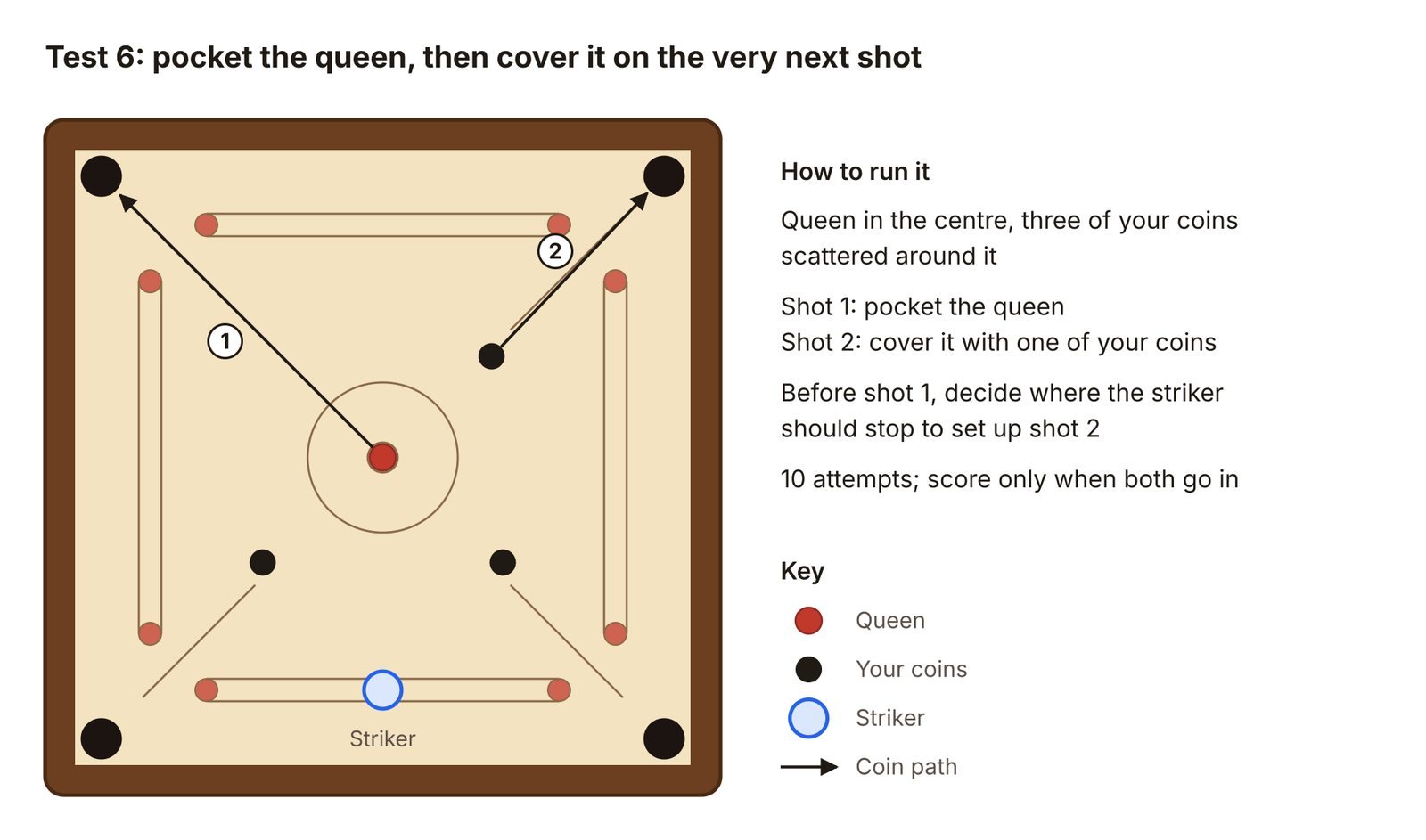
What it tells you: whether you can plan a two-shot sequence. If you pocket the queen 8 times but only cover 4, your problem is where the striker ends up after the queen, not the queen shot itself.
Test 7: The break
Take ten breaks. Write down how many coins went in on each, and whether you had at least one easy follow-up shot afterwards.
What it tells you: break power and accuracy. A break that pockets nothing but spreads the coins nicely for you is often better than one that sinks a coin and leaves a mess.
Test 8: Pressure shots
This is the one people skip, and it’s the one I value most. Choose a shot you normally pocket 8 out of 10 times. Now play it with a consequence: if you miss, you start the whole set of ten again. Or ask a friend to watch and keep score out loud.
What it tells you: how much of your skill survives pressure. If your 8 drops to 5, you have found something to work on that no ordinary practice would have shown you.
The tests at a glance
Watching yourself in real matches
Practice tests show what your hands can do. Matches show what you actually do. The two are often very different.
After a match, I jot down a few numbers on a scrap of paper. It takes two minutes:
- Fouls and dues. How many times did the striker go into a pocket, or did you pocket an opponent’s coin? These are free points you gave away.
- Easy misses. Shots you would make 9 times out of 10 in practice. Even two or three of these per match tells you that nerves or rushing are costing you.
- Turns where you cleared three or more coins. This shows whether your positioning is carrying from one shot to the next.
- Queen results. How many times did you pocket the queen, and how often did you cover it?
- The board you lost the worst. What went wrong? Write one honest sentence.
Also play different kinds of opponents. I used to beat the aggressive hitters at our club easily and lose to one quiet older man who never seemed to do anything special. It took me a while to realise he was simply never leaving me an easy shot. Playing him every week taught me more about defence than any book could. If you only play people you can beat, you’ll never find out where your game is thin.
If you can, film a few of your practice sessions or matches on your phone. Prop it up at the side of the board at striker height, or above if you can manage it. You’ll spot things you never feel while playing: your head moving at the moment of the shot, your striker placement creeping to one side, or your fingers flicking at a different angle when you’re tired. Compare a video from this month with one from two months ago. Improvement is often much easier to see than to feel.
Turning your results into improvement
Testing yourself is only useful if you act on what you find. This is the routine I follow and teach.
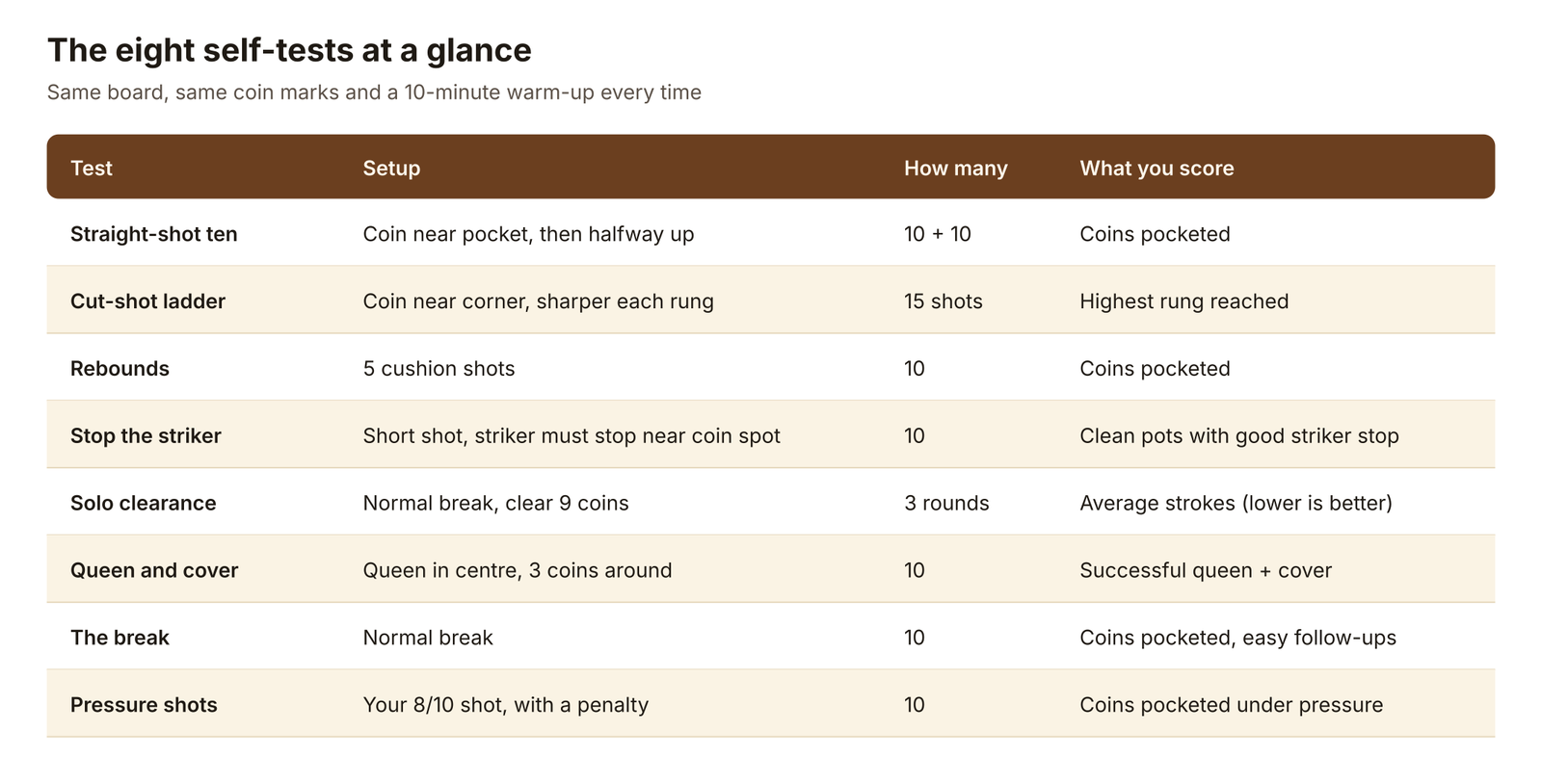
- Take your starting scores. Run all eight tests over two or three sessions and write the results down. Don’t worry if some look bad. This is just your starting point.
- Pick one weakness, not five. Look for the lowest score that matters most in games. For most players it’s speed control or cut shots. Trying to fix everything at once usually means fixing nothing.
- Practise it on purpose for two or three weeks. Spend about half of each practice session on that one skill. Short, focused sessions of 30 to 40 minutes are better than three hours of tired, careless shots.
- Keep playing games, too. The other half of your time should be real games or solo clearances, so the new skill gets used in a game situation.
- Retest under the same conditions. Same board, same marks, same warm-up. Compare with your starting scores.
- Decide what’s next. If the score has gone up and held for two tests in a row, move on to the next weakness. If it hasn’t moved, change how you’re practising it. Ask a better player to watch, film it, or slow the shot right down.
A word of warning: you will sometimes get worse before you get better. When I changed my grip on the striker, my straight-shot score fell from 9 to 6 for almost two weeks. It felt terrible. Then it climbed back to 9 and kept going up to a steady 10. If you’re changing.
A sample progress log
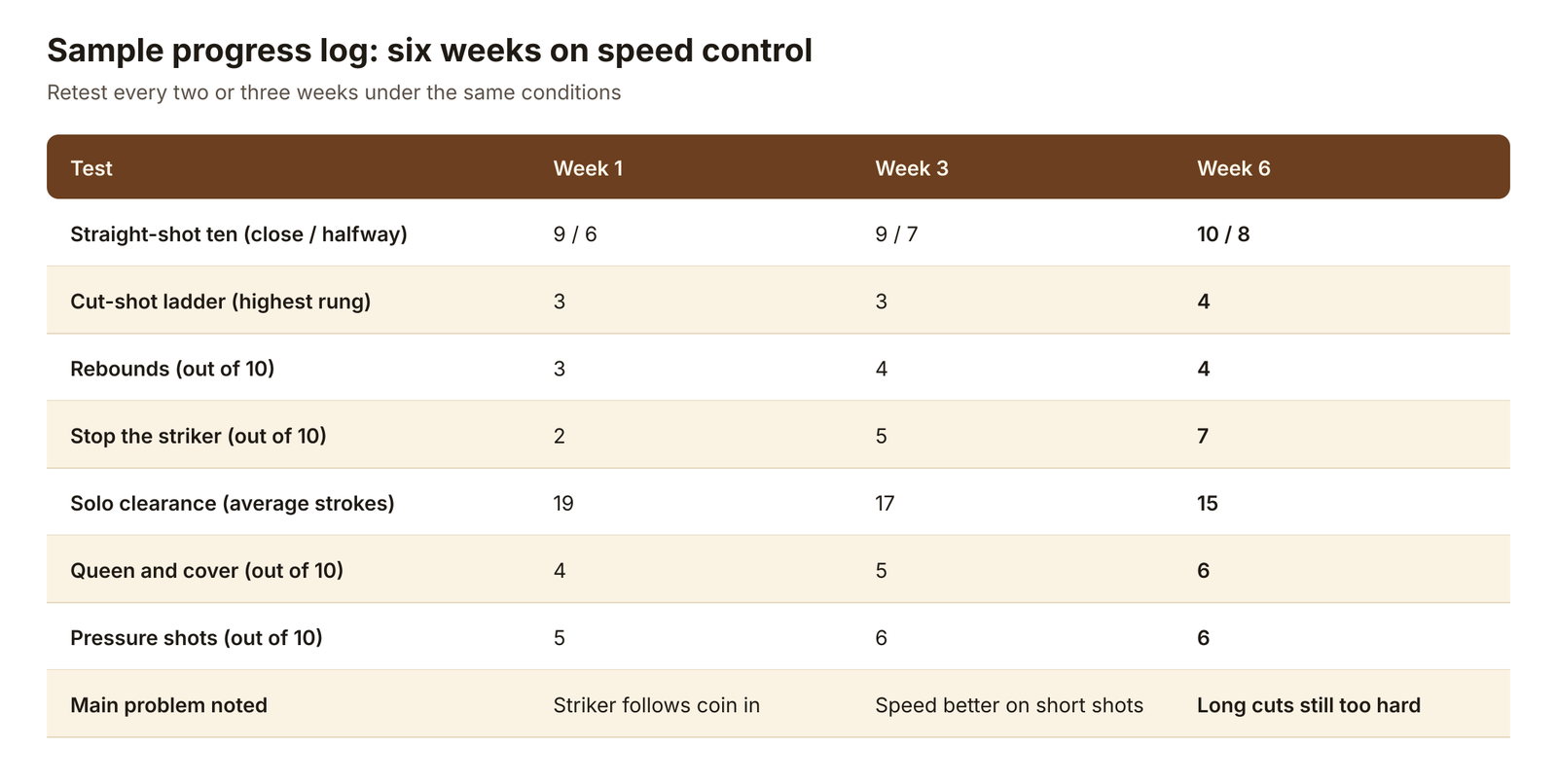
Look at what happened. He only worked on speed control, but his clearance score also improved by four strokes and his queen-and-cover went up. That’s normal. Skills in carrom are connected. Fix the striker and many other things improve with it. His next focus, written right there in the last row, was the long cut.
Improvement in carrom comes in small steps you hardly notice, and then all at once. You might go two or three weeks feeling stuck. Then one evening you realise you just played a cut shot without hesitating, the same shot you used to avoid.
So don’t measure yourself only by wins or by how many coins you pocketed today. Measure your consistency, your striker control, your planning, your decisions and how you hold up under pressure. Test yourself every few weeks, write it down, and work on one thing at a time.
Most of all, keep enjoying the game. I’ve played carrom for most of my life and I still find something new to learn almost every time I sit down at the board.
A good carrom player isn’t someone who never misses. It’s someone who knows why they missed, and what to do differently next time. Good Luck 🙂

I needed this. Thank you for sharing sir.
My pleasure 🙂