When you first start playing carrom, it’s easy to judge yourself by one number: how many coins you pocket.
If most of your coins go in, you feel like a good player. If you miss a couple of easy ones, you start wondering what went wrong. I thought exactly like that when I was learning. It took me a long time to see that getting better at carrom is about much more than pocketing coins.
Improvement is often quiet. The biggest changes tend to happen in how you set up a shot, how well you control the striker and whether you’re thinking about the next move before you play this one. You can be improving for weeks without noticing.
Here are seven signs I look for in my own game and in the players I help, along with a simple drill for each one so you can check where you stand.
1. Easy shots start going in every time
This is usually the first improvement you’ll notice.
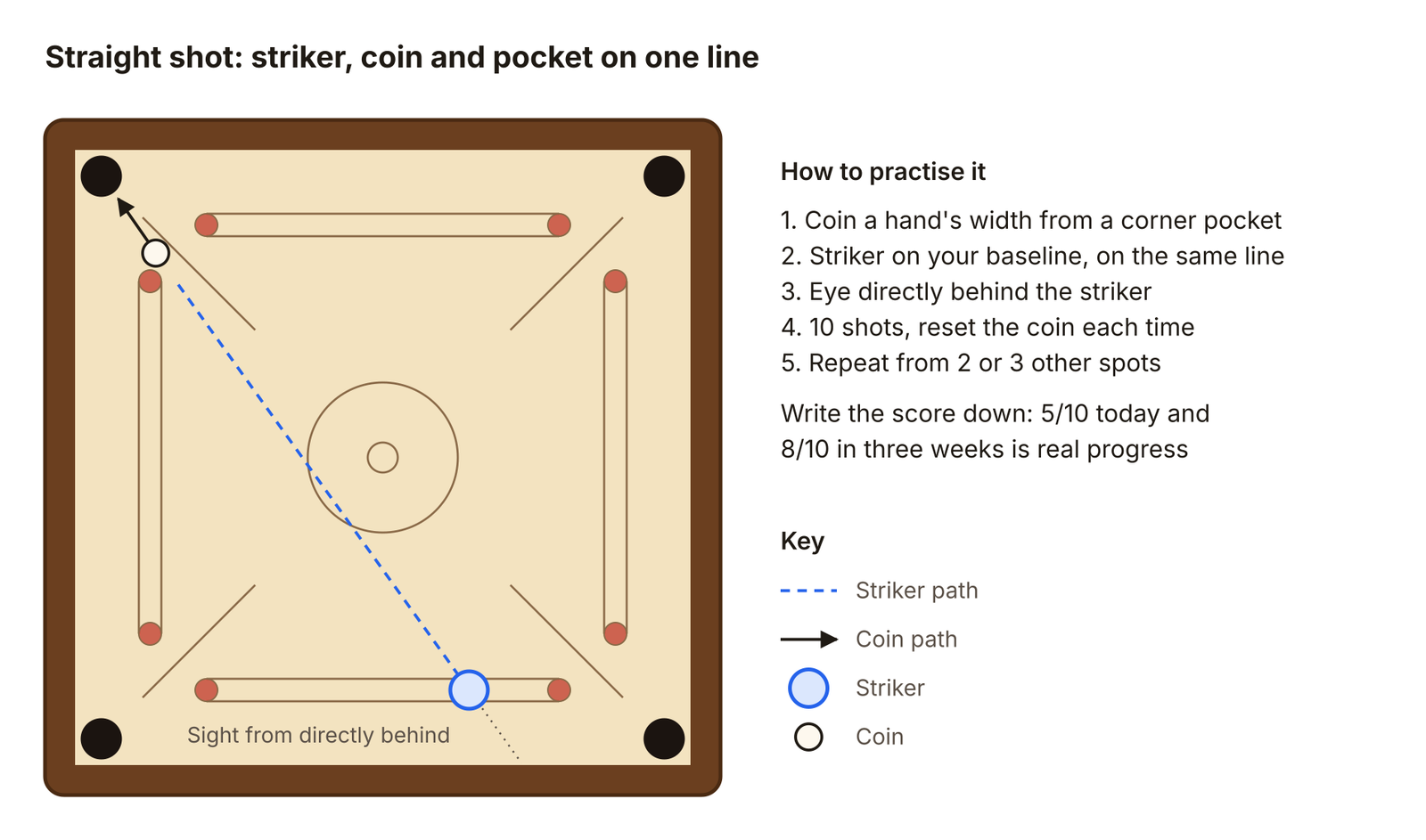
A straight shot looks simple, but there’s a lot going on. Your striker has to sit exactly on the line through the coin and the pocket. Your finger has to flick it straight along that line, and the force has to be just enough. Beginners usually get one of those three slightly wrong, and the coin clips the edge of the pocket and stays out.
When I was fixing my straight shots, I stopped playing full games for a couple of weeks. I put a coin in the same spot every evening and played the same shot over and over. The goal wasn’t just to pocket it. I wanted to know why one attempt went in cleanly and the next one rattled out. Most of the time the answer was my alignment: I was sighting from slightly to one side instead of directly behind the striker.
Try this drill:
- Place a coin about a hand’s width in front of a corner pocket.
- Put your striker on your baseline so that striker, coin and pocket form one straight line.
- Crouch so your eye is directly behind the striker, and check the line before every shot.
- Take 10 shots, putting the coin back in the same spot each time. Count how many go in.
- Repeat from two or three other positions along your baseline.
Write your scores down. If you’re on 5 out of 10 today and 8 out of 10 in three weeks, that’s clear proof your accuracy is improving.
Don’t worry about the misses. Focus on repeating the same setup every time: same stance, same sighting, same finger action. Accuracy follows a repeatable technique.
2. You control the striker instead of just hitting it
One thing I noticed when I started watching good players closely: they rarely hit hard. Many of the best players I’ve played against use surprisingly gentle, controlled shots.
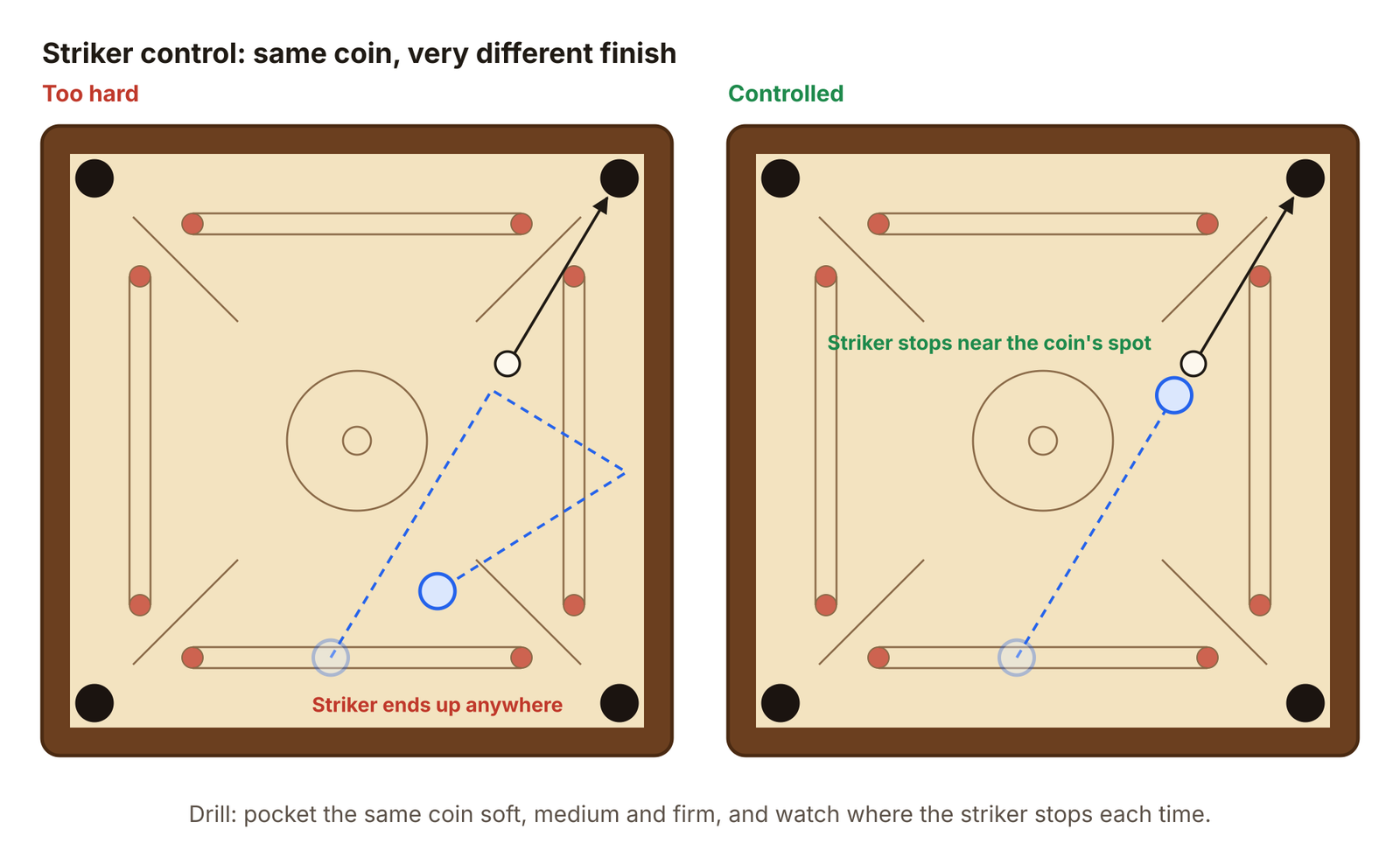
Beginners often think a harder hit gives them more control. It’s usually the opposite. A striker travelling too fast can still pocket the coin, but it then bounces around the board, knocks other coins out of position and sometimes follows the coin into the pocket, which costs you a penalty. Even when nothing goes wrong, you’ve handed yourself a random position for the next shot.
Good striker control means you choose two things before you play: where the coin goes, and roughly where the striker stops.
Try this drill:
Place a coin near the centre circle and pocket it three times, each with a different pace:
- Soft: just enough to reach the pocket. The coin should almost stop at the pocket’s edge before dropping in.
- Medium: your normal shot.
- Firm: noticeably harder, but still controlled.
After each shot, look at where the striker ended up. The goal is to pocket the coin with the striker stopping close to where the coin started, not rolling off to the far side of the board. Then move the coin to a new spot and repeat.
Over a few weeks you’ll build a feel for how much force each distance and angle needs. That feel is what separates a controlled player from someone who just hits and hopes.
3. Cut shots start to make sense
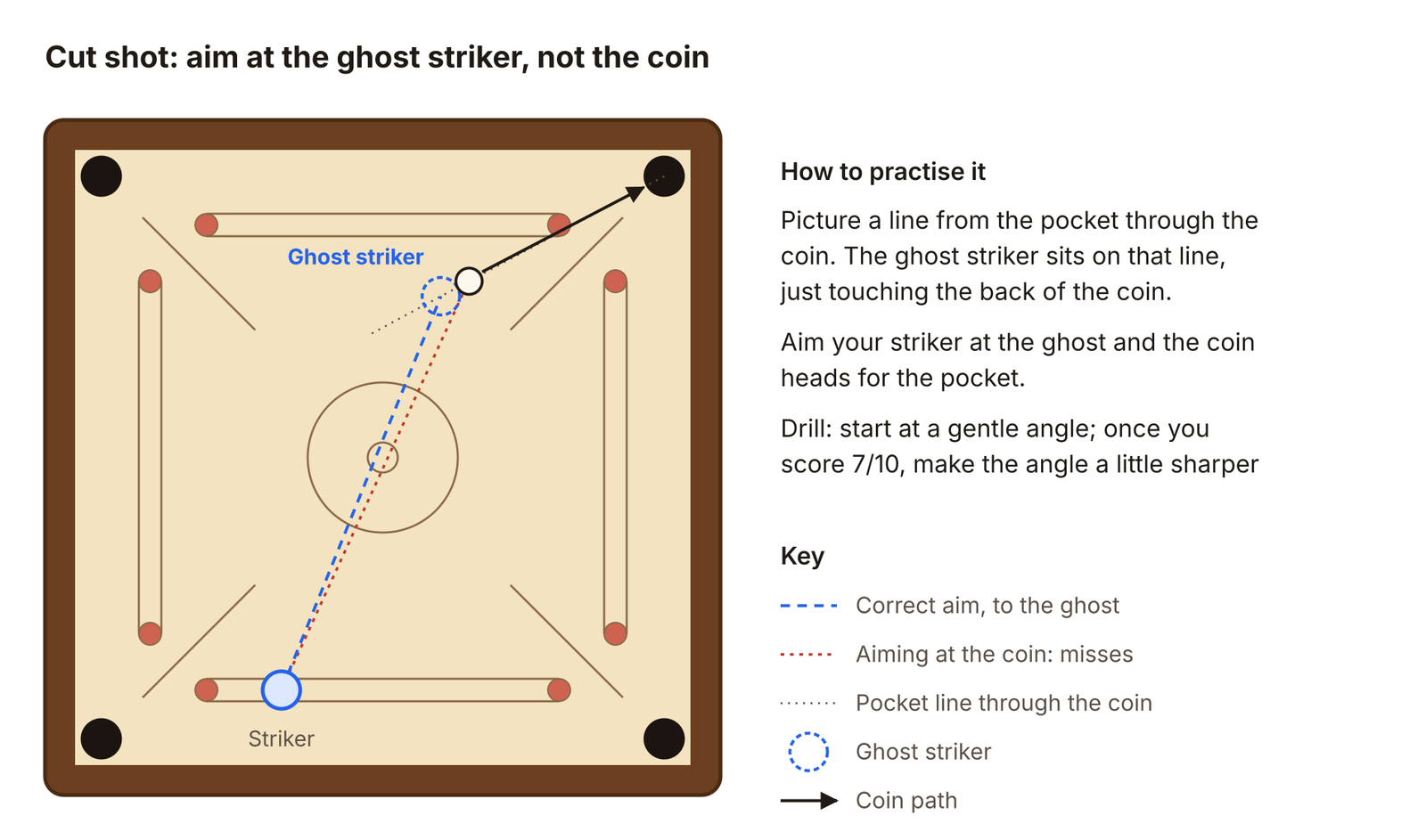
You can’t expect every coin to sit neatly in a line between your striker and a pocket. Most of the time it’s off to one side, and you have to play a cut: hit the coin on one side so it travels off at an angle toward the pocket.
At first, even a small angle feels impossible. The most common mistake I see is aiming the striker straight at the coin, or even at the pocket. Neither works for a cut.
Here’s the idea that made cuts click for me. Imagine a line from the pocket through the coin and out the other side. Now picture a “ghost” striker sitting on that line, just touching the back of the coin. That ghost striker is your target. Aim your real striker at the ghost, not at the coin, and the coin will head toward the pocket.
The further the coin is from your straight line, the thinner the contact gets, and the more precise you need to be.
Try this drill:
- Place a coin at a gentle angle from a corner pocket, only slightly off the straight line.
- Play it 10 times from the left side of your baseline, then 10 from the right.
- When you’re getting 7 or more out of 10, move the coin so the angle is a little sharper.
- Keep going until you find the angle where your score drops. That’s your current limit.
Don’t jump straight to thin cuts. Building up one step at a time teaches your eye to judge angles, and that skill carries over to every other shot.
4. You start thinking about your next shot
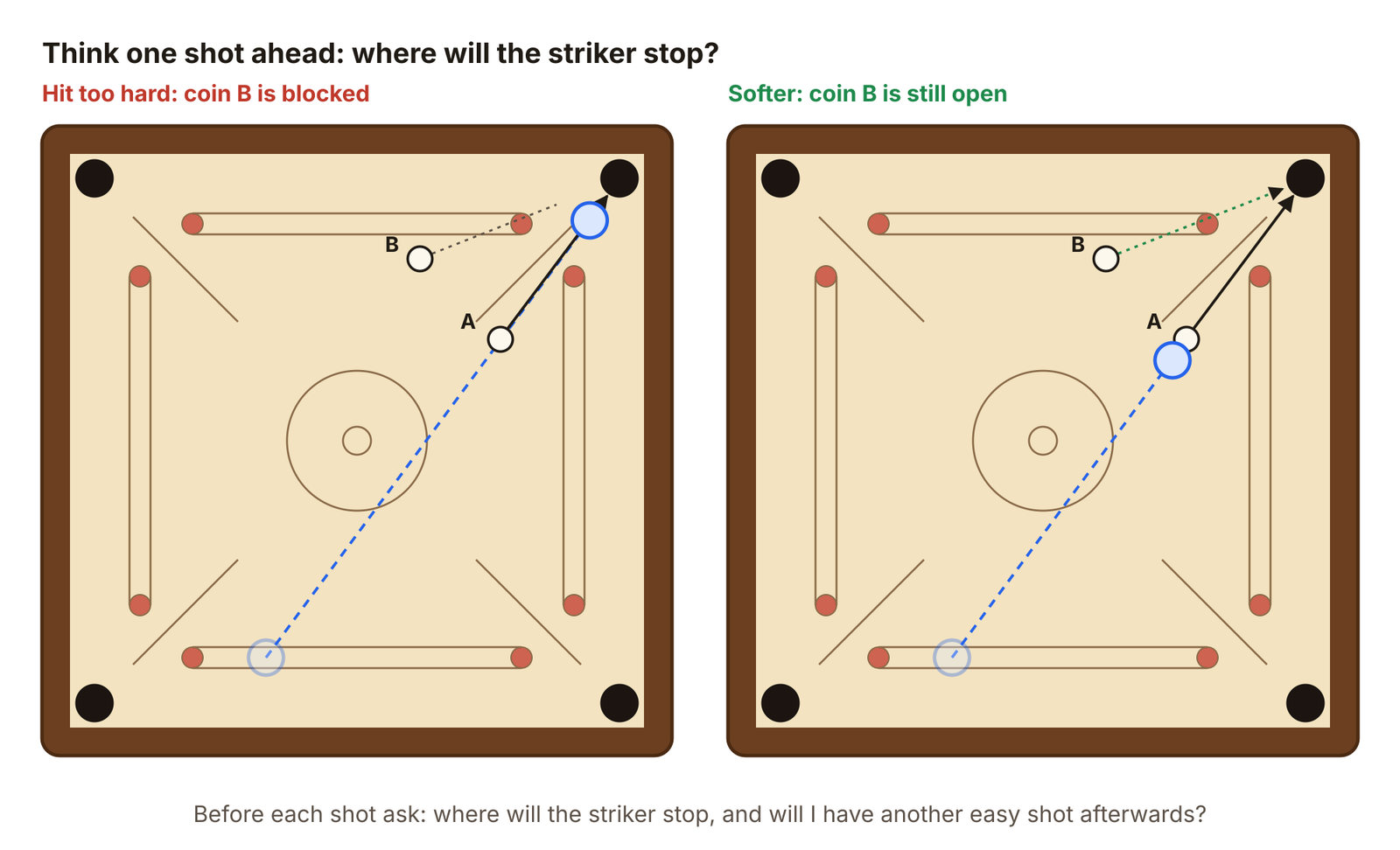
This is where you move beyond basic carrom.
A beginner looks at the coin they want to pocket. A more experienced player also looks at where the striker and the other coins will end up afterwards.
Here’s a situation that happens all the time. You have two coins close to the same pocket. You pocket the first one, but the striker rolls to a spot that blocks the second, or knocks it against the cushion where it’s hard to reach. You got a coin, but your position is now worse than before.
Now imagine the same board, but you play the first coin a little softer so the striker stops just short of the pocket area. The second coin is still sitting there, easy and open. Same skill, better thinking.
Before each shot, get into the habit of asking yourself three quick questions:
- Where is the striker likely to stop?
- Will I have another easy shot afterwards?
- If I miss, am I leaving my opponent an easy coin?
You won’t always get the position you want. But just asking these questions will change the shots you choose, and that’s real progress.
5. Rebound shots stop scaring you
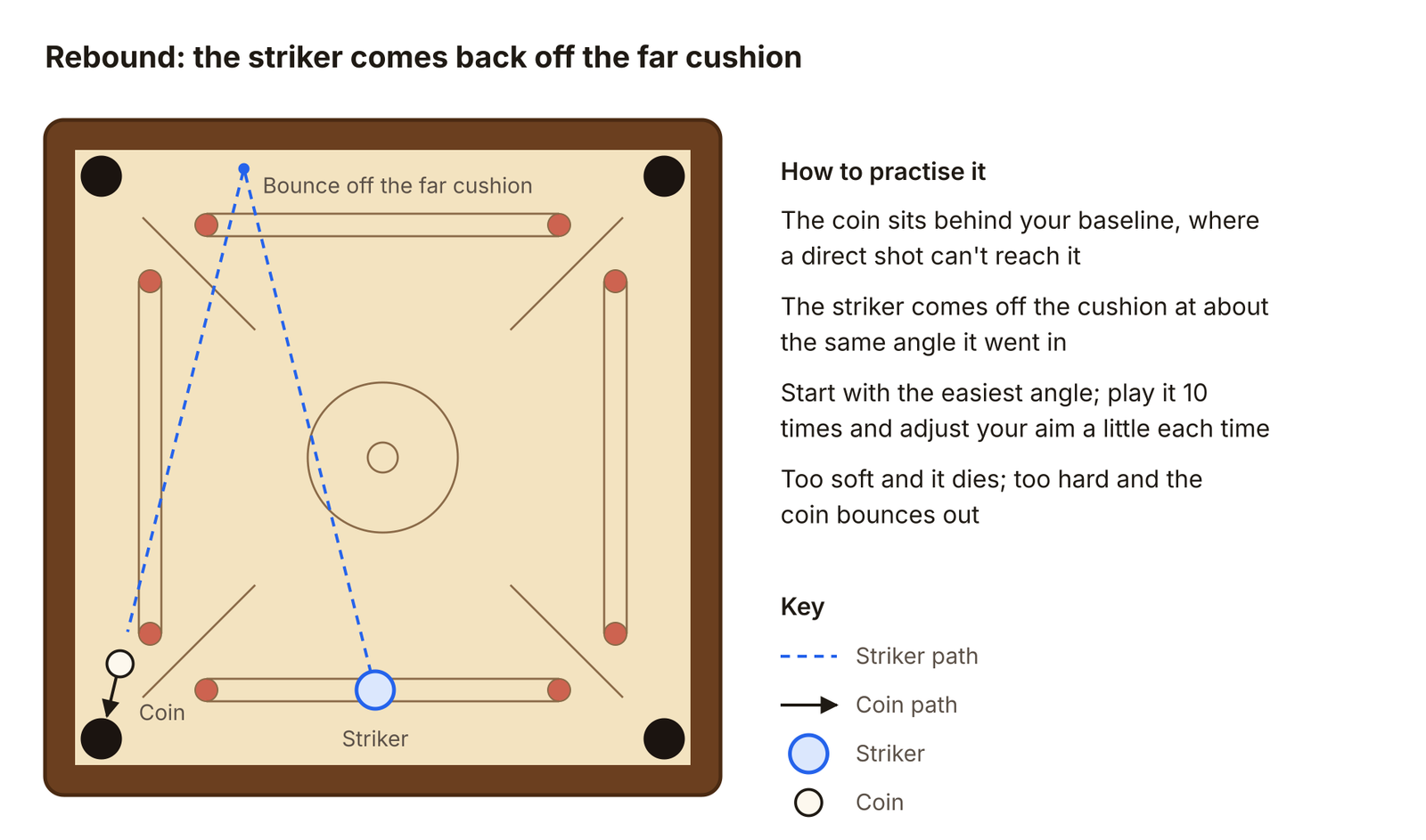
Rebounds are the shots you need when there’s no direct path to the coin. A typical case is a coin sitting behind your baseline, close to your own pocket, where you can’t hit it straight from your striking position.
Many beginners avoid rebounds completely because they look complicated. The truth is, simple rebounds follow a pattern you can learn. The striker comes off a cushion at roughly the same angle it went in, a bit like a ball bouncing off a wall.
Try this drill:
- Place a coin near the side cushion, just behind your baseline.
- Send the striker into the far cushion, the one facing you, so it comes back and hits the coin toward the pocket.
- Start with the easiest angle you can find and play it 10 times.
- Watch where the striker hits the cushion and which direction it comes back. Adjust your aim a little each time.
- Only move to a new angle once the first one feels comfortable.
Pay attention to speed as well as direction. Too soft and the striker dies before reaching the coin. Too hard and the coin bounces out of the pocket.
Don’t try to master every rebound at once. One reliable rebound is worth more than five you can only make on a lucky day.
6. You make fewer silly mistakes in matches
One of the biggest signs of improvement is how you handle pressure.
In practice you might pocket ten coins in a row without a problem. Then you sit down against a real opponent and suddenly you’re rushing, hitting too hard and going for shots you’d never attempt on your own. I’ve watched plenty of players who look brilliant in practice fall apart in the first close game.
That’s why I always recommend playing practice matches, not just practising individual shots. And if you can, play against someone a bit better than you. You’ll lose a few games, but you’ll discover weaknesses that solo practice never shows you.
After each match, ask yourself honestly:
- Did I rush any shots?
- Did I miss coins I’d normally pocket in practice?
- Did I struggle when the board was crowded?
- Did I give my opponent easy chances?
- Did I stay focused when I was behind?
If the answers are slowly changing from “yes” to “not as often”, you’re getting better, whatever the scoreline says. Winning is great, but learning to play well in difficult moments matters just as much.
7. You record your practice and actually learn from it
This is something I strongly recommend, especially if you practise alone.
You can be sure you’re striking correctly and still be doing something slightly different every time. A recording shows you what you can’t feel while playing.
You don’t need an expensive camera. A phone is enough. Prop it up behind your striking position at about board height, so you can see the line of your shot. If you can, take a second clip from above to see the angles.
Record ten straight shots and ten cut shots. Then watch your best and worst attempts side by side. Look for small differences:
- Is the striker in exactly the same spot on the baseline?
- Does your head or shoulder move at the moment you strike?
- Is your finger flicking straight through, or slightly across the striker?
- Are the misses all hit harder than the shots that went in?
When I first did this, I found my wrist was turning slightly on almost every missed cut. I never felt it while playing. Fixing that one habit did more for my cut shots than a month of extra practice.
Keep an old clip and compare it with a new one every month or so. Improvement is often much easier to see than to feel.
A simple practice routine for beginners
You don’t need to spend hours at the board every day. A focused session of 40 to 45 minutes, done regularly, will do more for you than one long weekend session.
Here’s a routine you can start with:
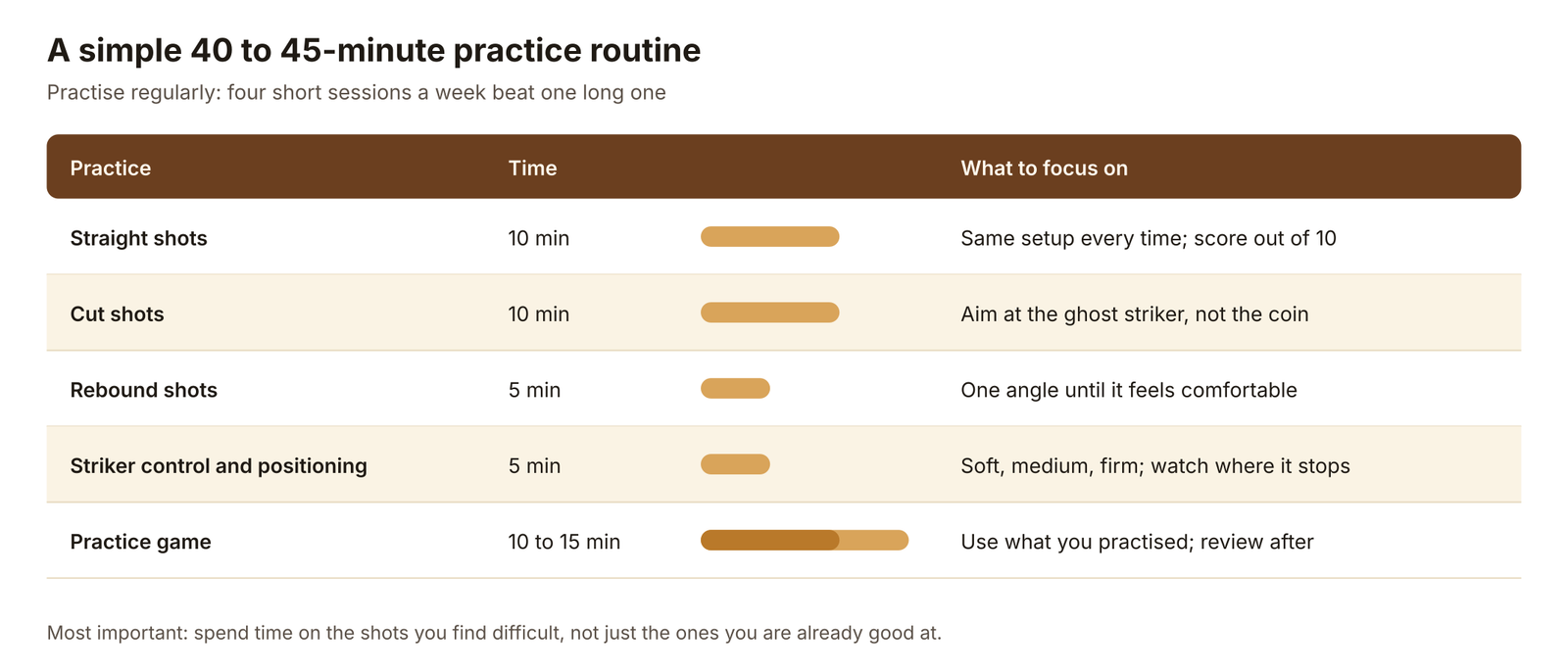
Adjust the times to suit your schedule. What matters most is playing regularly. Four 40-minute sessions a week will help far more than one four-hour session followed by a week away from the board.
And don’t spend all your time on the shots you’re already good at. It’s tempting, because it feels good. But the shots you avoid are exactly the ones holding you back.
Final thoughts
If I could tell a beginner just one thing, it would be this: don’t measure your progress only by the games you win.
Look instead at how many easy shots you now pocket without thinking, how well you control the striker, how comfortable you are with angles, and whether you’ve started thinking one or two shots ahead.
You might still lose to an experienced player after months of practice. That’s completely normal. There will always be someone at the board who can teach you something new, and that’s part of what makes the game worth playing.
Carrom is a game of small margins. A slightly better angle, a little more striker control or one smarter decision can turn a whole game around.
The real sign that you’re becoming a better carrom player is when you stop simply hitting coins and start understanding the game. Good Luck 🙂