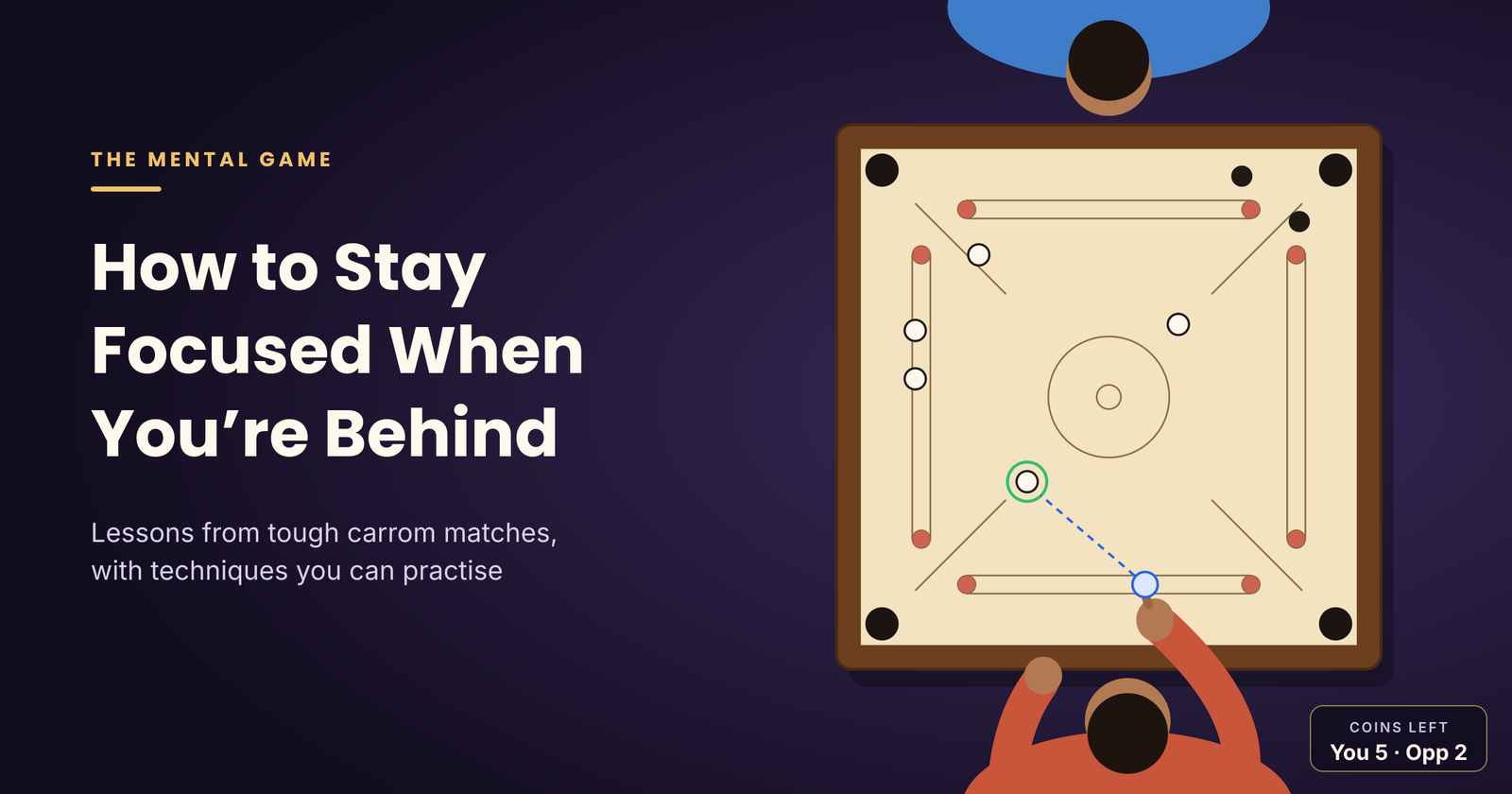
A few years ago I was playing a quarter-final at a club tournament. My opponent broke well, cleared six coins in his first two turns and had the queen covered before I’d really settled in. He was down to two coins. I still had five, and two of them were stuck against the cushion near his pocket.
I remember exactly how it felt. My hands went a little cold. I started hitting harder. I went for a thin cut I would never normally play, missed it, and left him a straight shot. I lost that board without pocketing another coin.
What bothered me afterwards wasn’t the loss. It was that I hadn’t really been beaten by his skill. I’d been beaten by the scoreline, and by what it did to my head.
Since then I’ve played a lot of matches from behind, and I’ve won more of them than I ever expected to. Not because my shots suddenly got better, but because I learned how to stop the pressure from making my decisions for me. Carrom boards can turn very quickly. One missed shot from your opponent, one coin that rolls your way, and you’re right back in it. But only if you’re still thinking clearly when that moment comes.
Here’s what I’ve learned, mostly the hard way.
1. Stop counting the score
This is the most important lesson, and the hardest one to actually do.
When you’re behind, your brain starts doing maths without being asked. He has two left, I have five. If he pockets one more, I need four in a row. If I miss again, it’s over. None of that helps you play the shot in front of you. It just fills your head with noise at the exact moment you need it quiet.
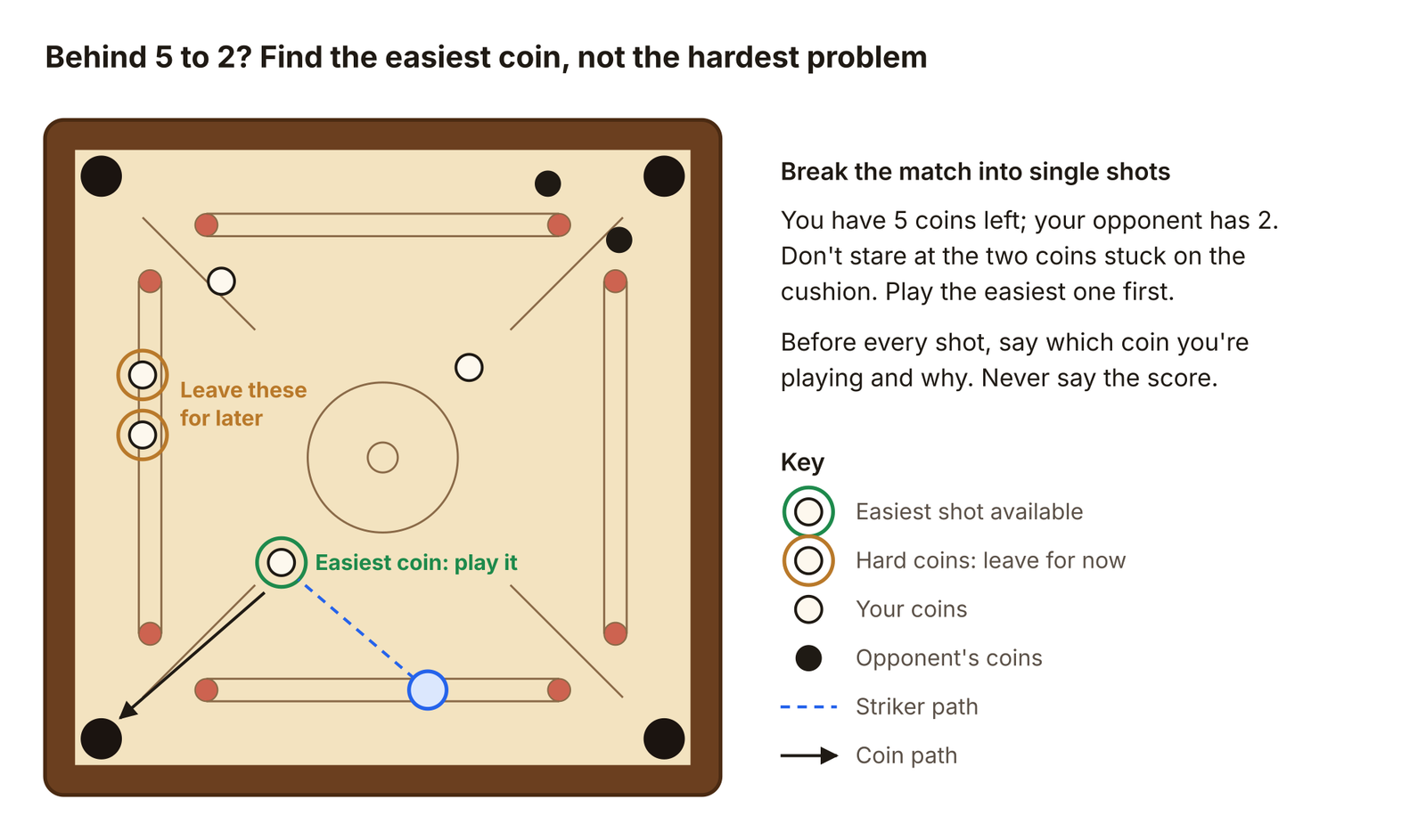
So don’t look at five coins as one big problem. Look at the board and ask a smaller question: which of my coins is the easiest to pocket right now? Play that one. Then look again.
In that quarter-final I told you about, I had at least two simple shots available. I didn’t see them, because I was staring at the two coins stuck near his pocket and thinking about how impossible the board looked.
Try this in practice: Set up a board with five of your coins and two of your opponent’s. Before every shot, say out loud which coin you’re playing and why it’s the easiest option. Never mention the score. It feels a bit silly at first, but it trains your attention to go to the board, not the scoreline.
The mental trick: Break the match into single shots. You’re not trying to win the board with this shot. You’re only trying to pocket this one coin.
2. Slow down when you feel the pressure
Watch players who are losing and you’ll notice something: they speed up. They sit down, glance at the board and hit. They skip checking the angle. They use more force than the shot needs, as if hitting harder will somehow make up for being behind.
I used to do exactly this. A friend who watched one of my matches told me afterwards that I was taking about half as long over my shots once I fell behind. I had no idea.
The fix is a pre-shot routine: the same few steps before every shot, whether you’re winning or losing. It doesn’t need to take long, maybe five or six seconds. What matters is that it’s the same every time, so your hands have something familiar to do when your head is busy panicking.
My pre-shot routine:
- Breathe. One slow breath out before you touch the striker.
- Pick the coin. Decide which coin and which pocket. Commit to it.
- Check the line. Crouch and look from behind the striker. Is the angle right?
- Choose the pace. Soft, medium or firm. Decide before you strike, not during.
- Strike. Trust the decision and play the shot.
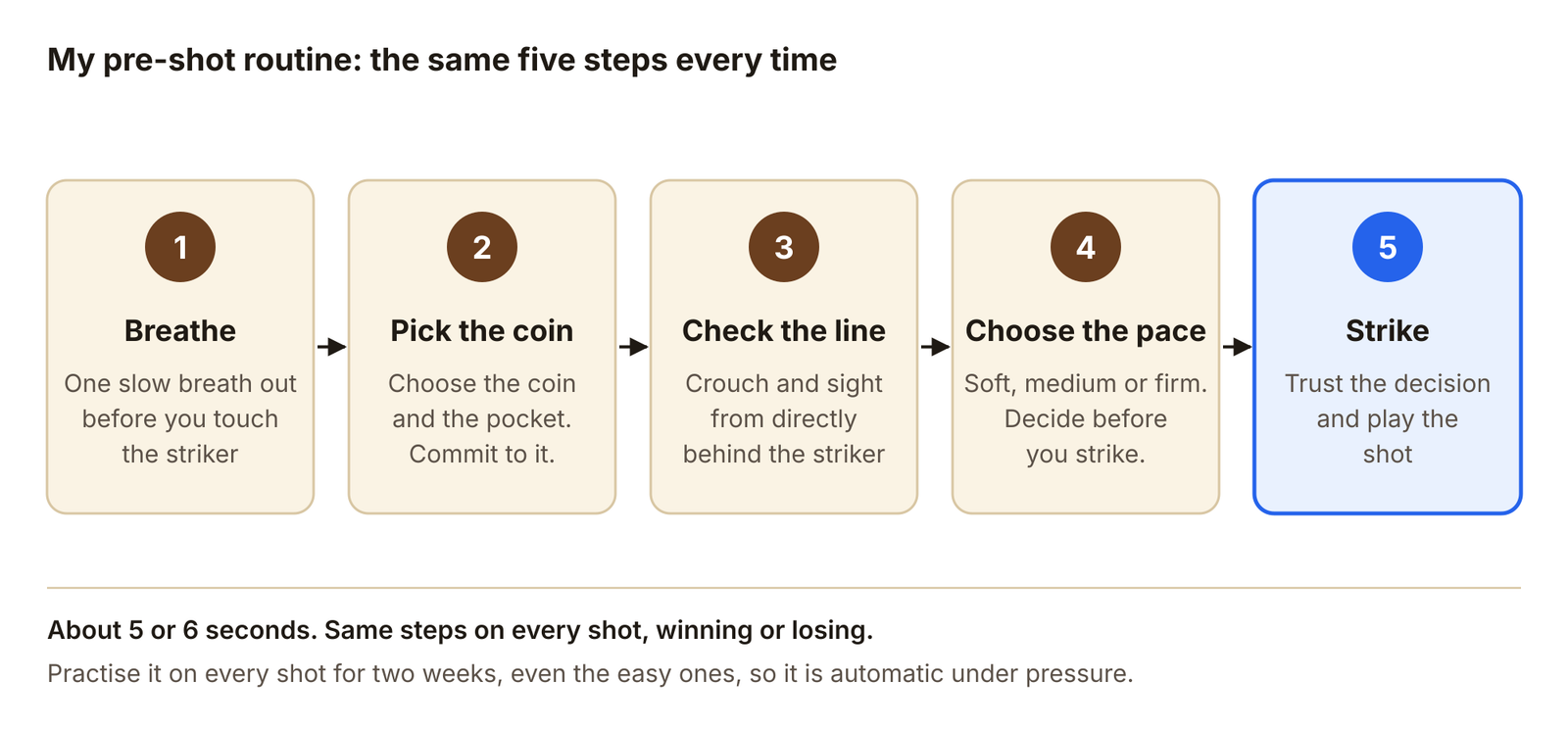
Try this in practice: Use the routine on every single shot in your practice games for two weeks, even the easy ones. It will feel slow and unnatural at first. That’s fine. You’re building a habit that will still be there when your heart is racing in a match.
3. Don’t try to win it back with one hero shot
This is the mistake I see most often, and I’ve made it more times than I’d like to admit.
You’re several coins behind. You spot a really difficult shot, maybe a thin cut along the cushion or a double. If it goes in, it changes everything. So you go for it, because it feels like you need something special.
Sometimes it works, and it feels brilliant. But most of the time it misses, and a miss from that kind of position usually leaves your opponent something easy. You were three coins behind. Now you’re three coins behind and they’re about to finish.
There’s a difference between playing aggressively and playing desperately. Aggressive play is choosing shots you can actually make, at a good pace, one after another. Desperate play is choosing shots because you need them to go in.
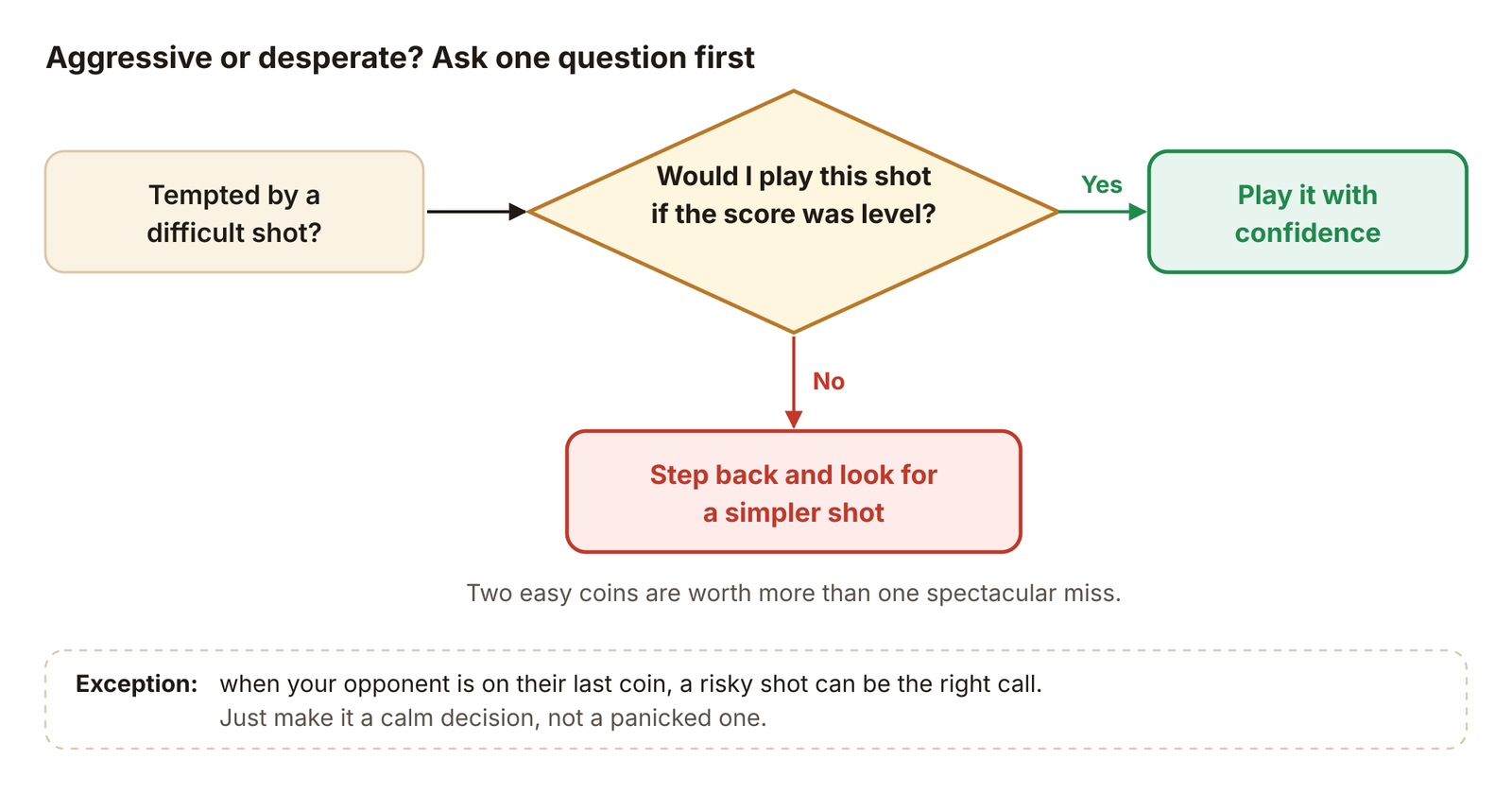
The mental trick, my favorite question: “Would I play this shot if the score was level?”
If the answer is yes, play it with confidence. If the answer is no, step back and look for something simpler. Two easy coins are worth more than one spectacular miss.
There are times when a risky shot is the right call, for example when your opponent is on their last coin and an easy shot for you won’t change anything. But that should be a calm decision, not a panicked one. The question helps you tell the difference.
4. Keep watching your opponent’s shots
When you’re losing, it’s tempting to switch off while your opponent plays. You look at the floor, sip your water and wait for your turn. I understand why. Watching them pocket coin after coin isn’t fun.
But being ahead doesn’t make anyone perfect. Players who are winning often relax a little too much. They miss straightforward shots, leave the striker in awkward places or knock coins into new positions without noticing.
I once won a board I had no right to win because my opponent, needing just one coin, played it slightly too hard. The striker clipped one of my coins on its way and pushed it out from the cushion into the open. I’d been watching. I saw it immediately, and I’d already worked out the shot before he stood up.
If I’d been staring at the floor, I’d have sat down, looked at the board with the old plan still in my head, and probably missed that chance.
The mental trick: After every one of your opponent’s shots, do a quick board scan before you sit down. Ask three things:
- Has any of my coins moved into a better position?
- Is any coin now blocking a pocket, mine or theirs?
- Which parts of the board are now open, and which are crowded?
Then make a fresh plan. Never just carry on with the one you had before their shot.
5. Reset properly after a bad shot
Missing an easy coin when you’re already behind hurts. The miss itself is rarely what loses the match, though. It’s what you do in the next thirty seconds.
I’ve watched players miss a simple shot, shake their head, mutter at themselves and then miss the next one too. The first miss was bad luck or a small technical slip. The second one was frustration. The missed shot was still living in their head when they lined up the new one.
You can’t bring that coin back. The only shot that matters now is the next one.
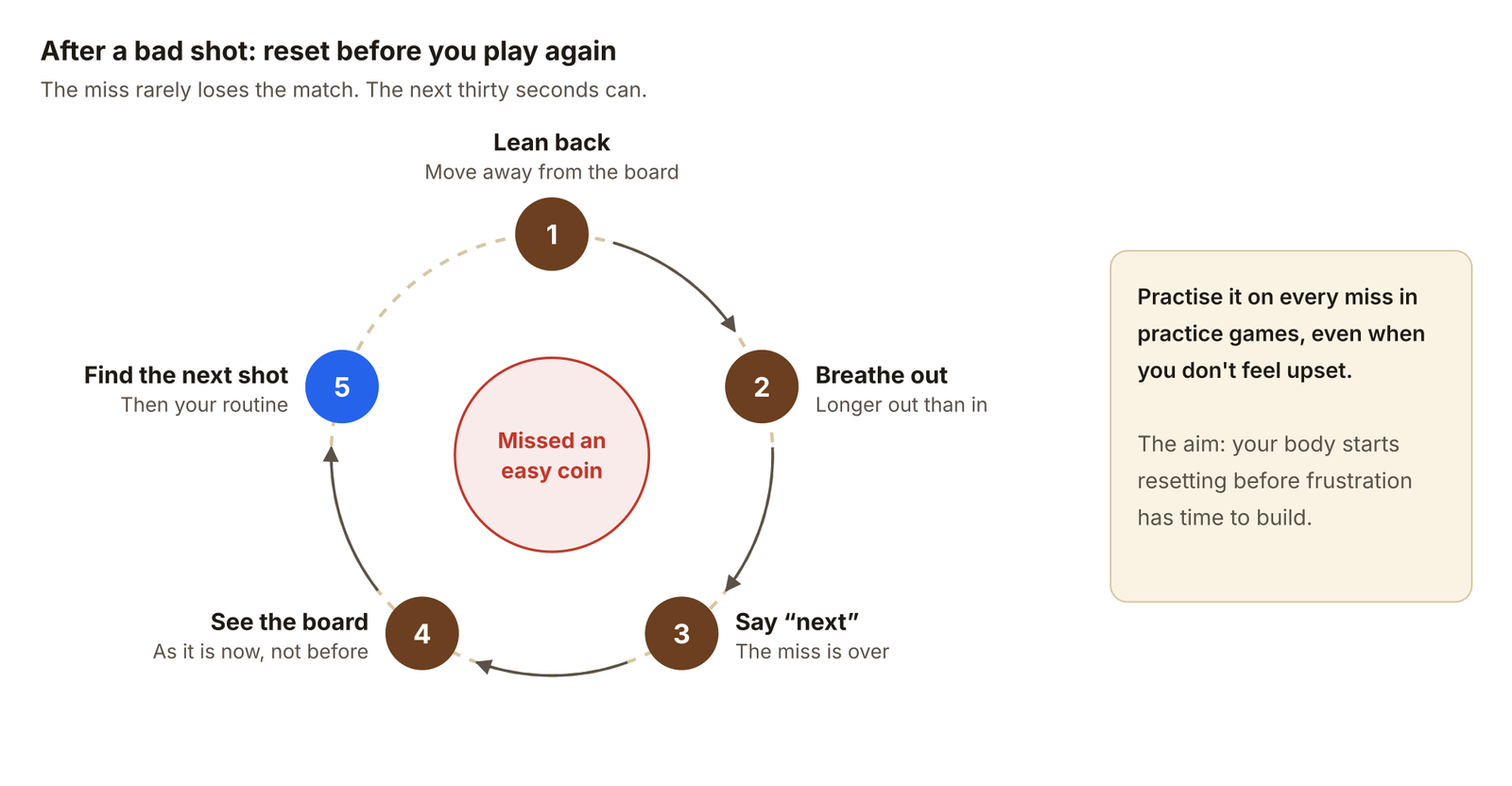
My reset routine:
- Lean back. Physically move away from the board for a moment, even just sitting back in your chair.
- Breathe out slowly. Longer out than in.
- Name it and let it go. Say a word to yourself, “gone” or “next”. I use “next”. It sounds silly, but it marks the end of that shot.
- Look at the board as it is now. Not as it was before the miss.
- Find your next opportunity. Then start your normal pre-shot routine when it’s your turn.
Try this in practice: Every time you miss in a practice game, do the full reset, even if you don’t feel upset. The point is to make it automatic, so that in a real match your body starts resetting before your frustration has time to build.
6. Think about position, not just pocketing
When you’re behind, it feels like every shot has to pocket a coin. Anything else feels like wasting a turn you can’t afford.
But sometimes the smartest shot doesn’t pocket anything. Say your remaining coin is tucked against the cushion where you can’t pocket it cleanly, and your opponent’s last coin is sitting near an open pocket. A wild attempt at your coin will probably miss and could even knock their coin closer. A controlled shot that nudges their coin away from the pocket, or parks one of yours in front of it, makes their next turn much harder. That buys you another turn, and another chance.
The right choice always depends on the board. But good players don’t only ask, “Can I pocket this?” They also ask, “What does the board look like after I play this?”
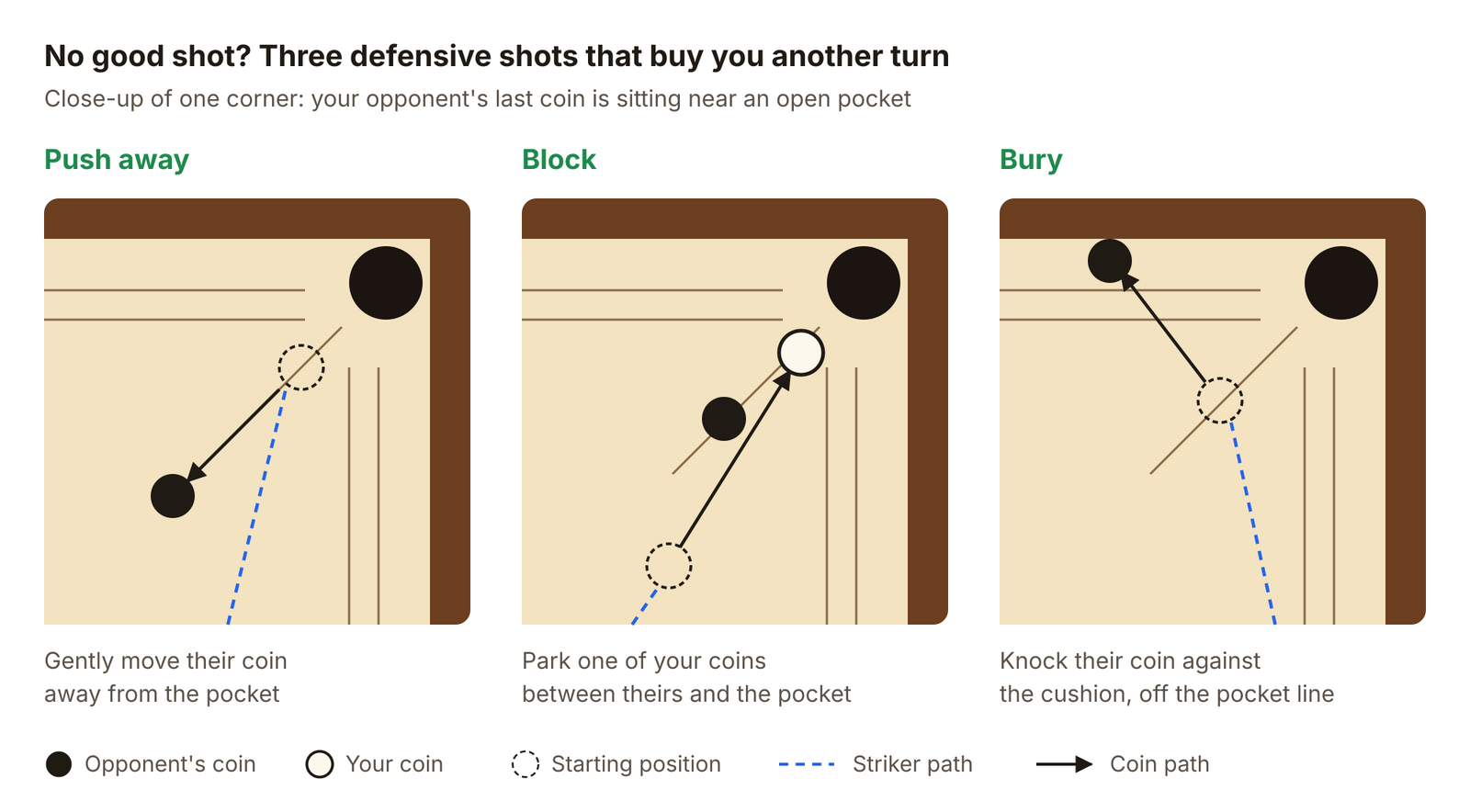
Try this in practice: Once a session, set up a board where your opponent has one coin near a pocket and you have none you can pocket easily. Practice three defensive shots:
- Push away: gently move their coin away from the pocket.
- Block: leave one of your own coins sitting between their coin and the pocket.
- Bury: knock their coin against the cushion where it’s awkward to play.
You won’t need these every match, but when you do, you’ll be glad you’ve practiced them.
7. Practice being behind on purpose
Most people only practice when the board is fresh and even. Then the first time they’re really under pressure is in a match that counts. No wonder it feels overwhelming.
A few years ago, a friend and I started playing what we called “comeback boards” once a week. One of us would start with a handicap, and the other had to try to win from there. The first few weeks, I lost nearly all of them. But slowly, being behind stopped feeling like an emergency. It just became another kind of board to play.
Comeback drills to try with a practice partner:
- Three down: Your partner removes three of their coins before the break. You play a normal board from there.
- Last coin: Your partner has only one coin left on the board, near a pocket. You have four or five. You get the first shot.
- Queen pressure: Your partner has already covered the queen. You need to win the board anyway.
- Silent scoreboard: Play a normal board where neither of you is allowed to mention the score, only the shot you’re about to play.
The goal isn’t to win every comeback board. You won’t. The goal is to make good decisions under pressure. After each board, spend two minutes talking it through: which decisions helped, and which ones were driven by panic?
8. Ask yourself one question
If you only remember one thing from this article, make it this.
Whenever I notice my mind drifting to the score, to the crowd or to the last shot I missed, I bring it back with one question:
“What’s the best shot I can play right now?”
Not the shot that wins the match. Not the shot that would look amazing. Just the best decision on the board in front of me, at this moment.
The reason it works is simple. It gives your mind a job it can actually do. You can’t control whether your opponent misses. You can’t make the score change by worrying about it. But you can always look at the board and find the best shot available. That’s completely in your hands.
Some players write it on a small card and keep it in their pocket during tournaments. I just say it to myself while I’m doing my pre-shot breath. Whatever works for you, make the question a habit, so it’s there when you need it most.
A simple match-day routine
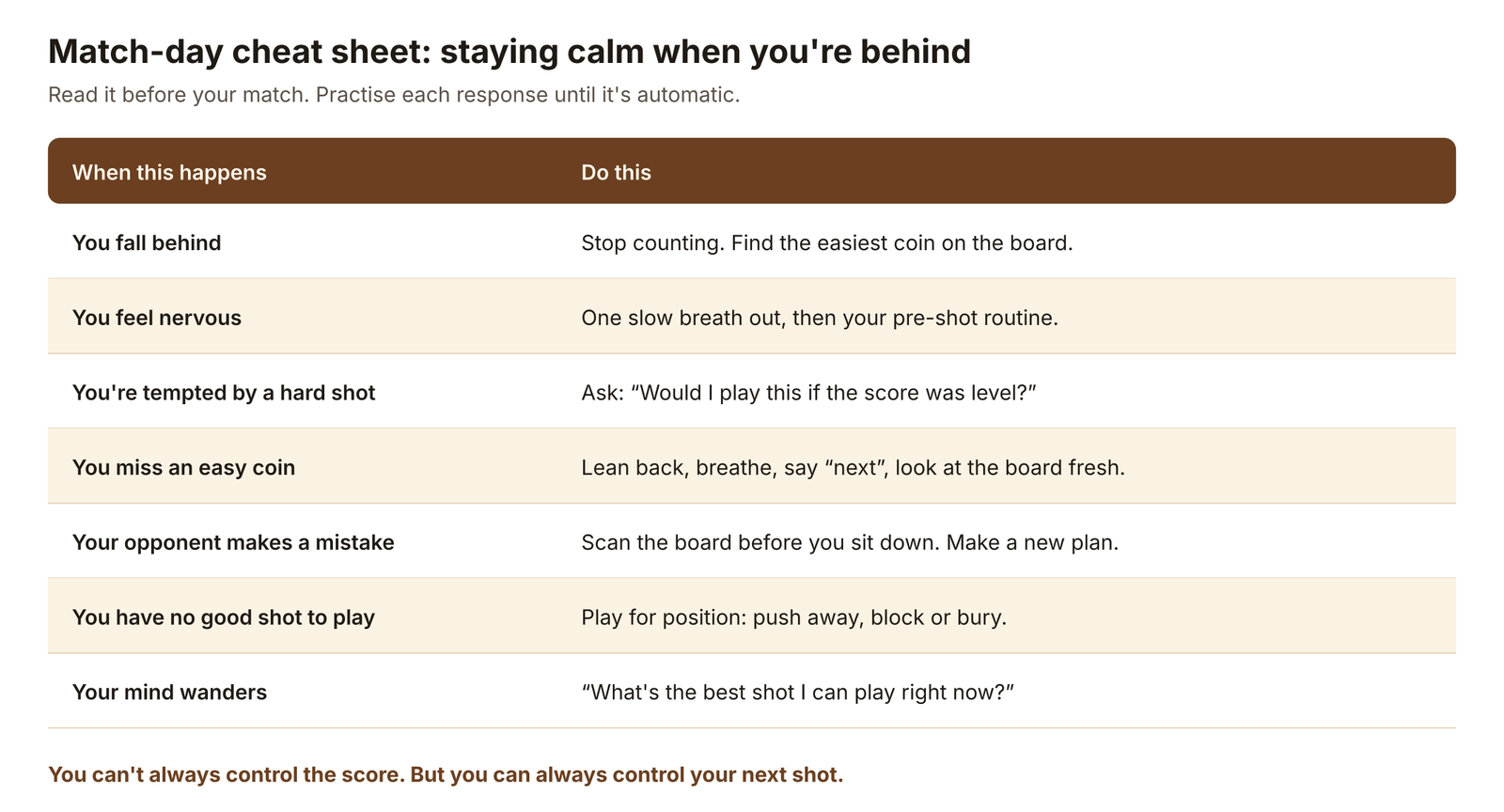
You don’t need complicated sports psychology. What helps most is a few simple responses that you’ve practised enough to use without thinking. Here’s the cheat sheet I’d give anyone heading into a tournament:
|
When this happens |
Do this |
|---|---|
|
You fall behind |
Stop counting. Find the easiest coin on the board. |
|
You feel nervous |
One slow breath out, then your pre-shot routine. |
|
You’re tempted by a hard shot |
Ask: “Would I play this if the score was level?” |
|
You miss an easy coin |
Lean back, breathe, say “next”, look at the board fresh. |
|
Your opponent makes a mistake |
Scan the board before you sit down. Make a new plan. |
|
You have no good shot to play |
Play for position: push away, block or bury. |
|
Your mind wanders |
“What’s the best shot I can play right now?” |
Write this out and read it before your next match. Better still, practice each response in your training sessions until it’s automatic.
If you play competitive carrom, you’re going to be behind a lot. Every player I know, including the very best ones I’ve faced, has boards where nothing goes right.
What separates players isn’t whether they fall behind. It’s whether they keep playing the same way when they do. It’s easy to make good decisions when you’re three coins up and relaxed. The real test is making those same decisions when you’re three coins down and your hands are a little cold.
I still lose matches from behind. Plenty of them. But I rarely lose them the way I lost that quarter-final, by beating myself before my opponent had to.
So next time you’re behind, don’t panic, don’t rush, and don’t try to be a hero with one impossible shot. Take a breath, look at the board as it is right now, and play the best shot available.
You can’t always control the score. But you can always control your next shot. Good Luck 🙂